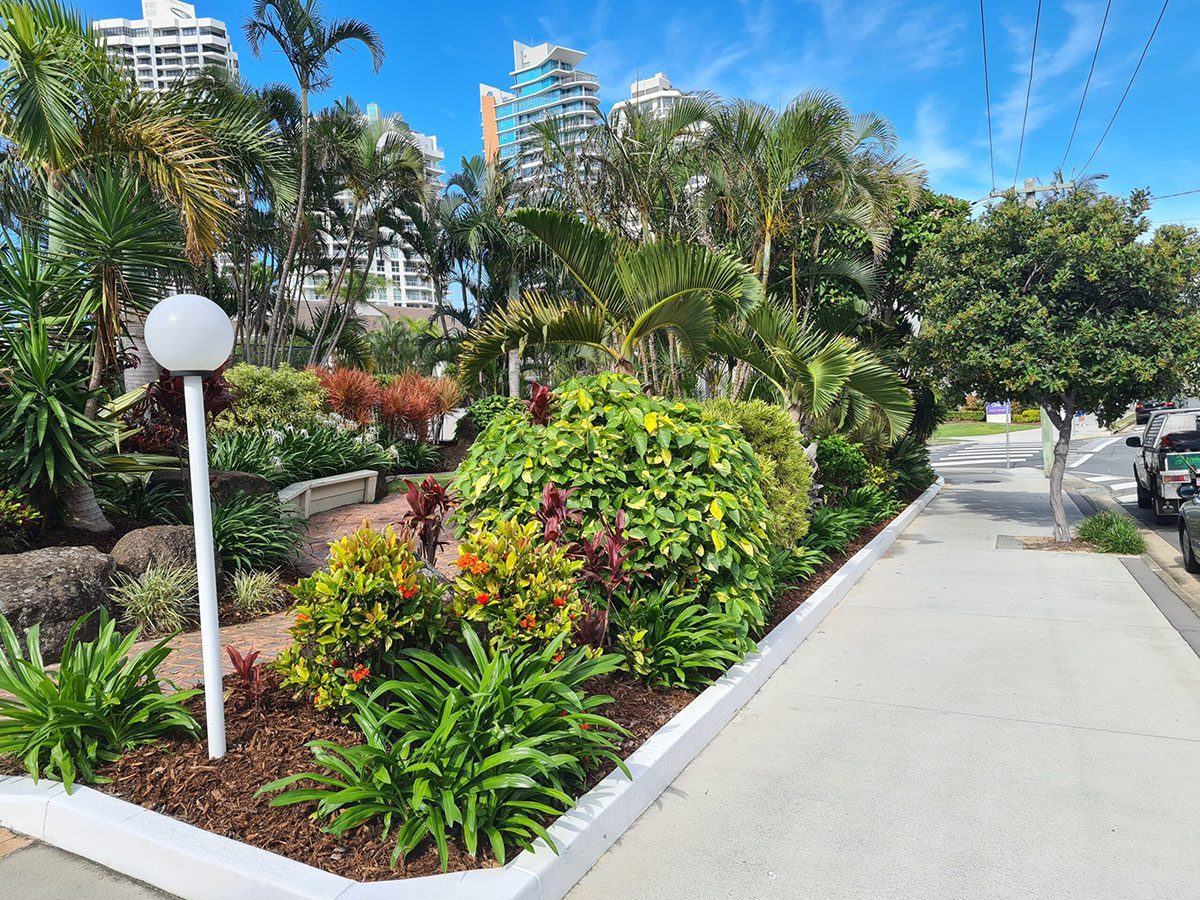
Queensland is different. The Gold Coast’s subtropical climate brings hot, humid summers, mild winters, and soils that range from sandy coastal beds to heavy western clay. These are conditions that reward the right native grass and quickly expose the wrong one. Most guides to native Australian grasses are written for the whole country. This one is written specifically for Queensland.
We cover the ten species that genuinely perform in our conditions, the ones to approach with caution, how to prepare your Gold Coast soil, when to plant, and how to care for your native grasses across every season. If you are looking to create a low-maintenance, wildlife-friendly garden on the Gold Coast or across South East Queensland, this is where to start.
Why Queensland Gardeners Are Choosing Native Grasses
Native Australian grasses have moved well beyond the specialist horticulture world. Homeowners, property developers, body corporates, and local councils across the Gold Coast and South East Queensland are making the switch — and for good reason.
They require far less water than conventional turf. Once established, most native grass species survive extended dry periods without irrigation. This significantly reduces water bills and keeps gardens looking well through Queensland’s increasingly variable summers.
They are lower maintenance. Most varieties need minimal mowing, little to no fertilising, and far less intervention than kikuyu, couch, or buffalo lawns. For busy households and property managers, this is a practical and financial advantage.
They support local biodiversity. Native grasses provide food and shelter for native birds, butterflies, and pollinators. For property owners near bush corridors on the Gold Coast Hinterland, planting native species helps maintain and extend existing wildlife habitat.
They suit the council and environmental requirements. Many new developments in South East Queensland are now required or encouraged to incorporate native species in landscaping plans, particularly near waterways and ecological areas.
Understanding Your Gold Coast Soil Before You Plant
Choosing the right native grass for your Gold Coast garden starts with knowing your soil. The Gold Coast is not a single soil type. It varies significantly across the region, and what performs well in one suburb can struggle in another.
Sandy coastal soils are common in beachside and near-coastal suburbs such as Palm Beach, Currumbin, Tugun, Burleigh, and Coolangatta. These soils drain rapidly and can dry out quickly in summer. Species planted here need strong drought tolerance and benefit from heavy mulching.
Clay soils dominate the newer growth corridors, including Coomera, Ormeau, Pimpama, and Arundel. Clay compacts easily, retains moisture, and can become waterlogged after heavy summer rain. Not all native grasses tolerate clay, and choosing the wrong species in these areas is one of the most common causes of planting failure.
Loam is found across many hinterland and mid-corridor suburbs, including Mudgeeraba, Reedy Creek, and parts of Robina. Loam is the most forgiving soil type for native grasses and gives you the widest species selection.
Rocky or nutrient-poor soils appear in elevated hinterland areas such as Tallai, Bonogin, and the Springbrook foothills. Hardy, drought-resistant species perform best in these positions.
If you are unsure of your soil type, dig down 20 centimetres and squeeze a handful of damp soil. Clay holds its shape firmly and feels slick. Sandy soil crumbles immediately and feels gritty. Loam holds shape briefly then crumbles apart.
The Best Native Australian Grasses for Queensland
The following ten species have been selected for their performance in South East Queensland’s subtropical climate. Each profile includes sun and soil requirements, and a specific note for Gold Coast gardeners.
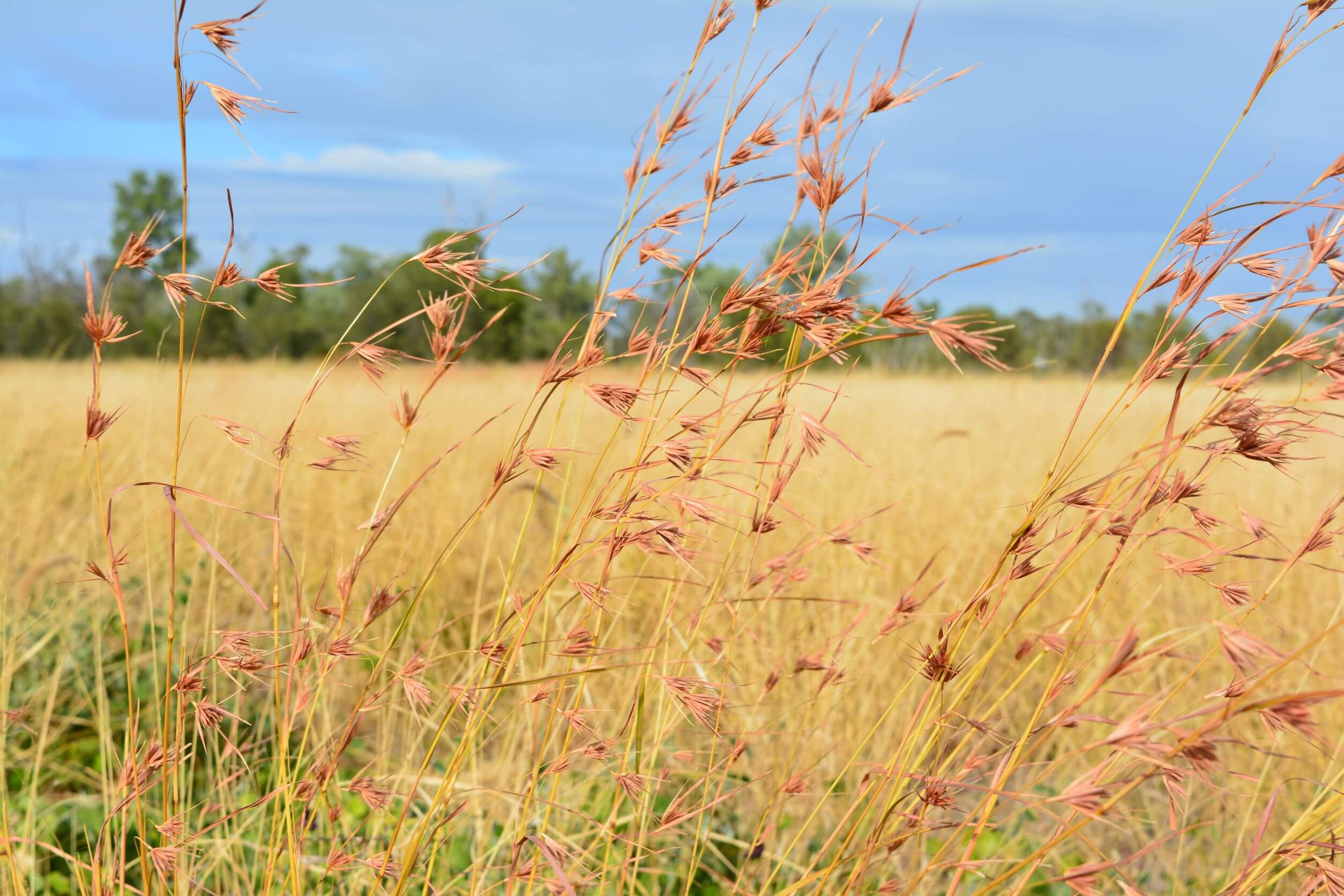
1. Kangaroo Grass (Themeda triandra)
Best for: Lawn alternatives, ornamental planting, wildlife habitat
Sun: Full sun
Soil: Most soil types including sandy, clay, and loam
Height: 0.4 to 1.0 metres
Kangaroo Grass is Thrive’s top recommendation for Gold Coast gardens. It is the most versatile native grass on the coast, adapting to nearly any soil type and thriving in Queensland’s subtropical conditions. The grass produces distinctive rust-red seed heads in summer that are visually striking and provide food for native birds.
It is a host plant for more than 13 butterfly species, making it a genuine ecological asset for any Queensland garden. Mass planting creates a naturalistic, meadow-style effect that works equally well in luxury residential projects and rural hinterland properties.
Gold Coast note: Cut back hard to 15 centimetres in early winter to encourage vigorous new growth in spring. Without an annual cut-back, dead material accumulates and the plant loses its form.
2. Lomandra ‘Katie Belles’ (Lomandra hystrix)
Best for: Erosion control, borders, clay and wet positions, low-maintenance planting
Sun: Full sun to part shade
Soil: Clay, loam, and wet or periodically waterlogged areas
Height: 0.8 to 1.2 metres
Lomandra ‘Katie Belles’ is the humidity champion of Queensland landscaping. This cultivar of the native Lomandra hystrix species was developed specifically for subtropical climates and is now one of the most widely planted native grasses across the Gold Coast, used in residential garden beds, council rain gardens, and retention basins.
Where many Lomandra longifolia cultivars struggle and die back in Gold Coast’s coastal humidity, Katie Belles performs reliably season after season. It handles clay soils and periodic waterlogging with ease — two conditions that are common across the western growth corridors of the Gold Coast.
Gold Coast note: This is the Lomandra to plant in humid coastal positions and clay soils. It requires very little intervention once established and suits both formal and naturalistic garden styles.
3. Lomandra ‘Shara’
Best for: Formal garden beds, mass planting, ornamental borders
Sun: Full sun to part shade
Soil: Most well-drained soils and clay
Height: 0.4 to 0.6 metres
Lomandra ‘Shara’ was the first compact, fine-leaf Lomandra to genuinely survive Queensland’s coastal humidity. For years, Gold Coast landscapers trialled fine-leaf Lomandra varieties that looked excellent in the display garden but struggled in the field. Shara changed that.
Neat, compact, and elegant, Shara suits formal planting schemes, driveway edges, and mass-planted bed areas. The low height and tidy form make it easy to maintain, and it requires minimal pruning to stay looking sharp.
Gold Coast note: An excellent alternative to exotic ornamental grasses in formal landscape designs. Use Shara where you want a fine-textured, polished look without the maintenance overhead.
4. Blue Flax Lily (Dianella caerulea)
Best for: Shade gardens, ornamental borders, underplanting, wildlife gardens
Sun: Full sun to full shade
Soil: Most soils
Height: 0.5 to 0.8 metres
Dianella caerulea is one of the few native grass-like plants that genuinely tolerates full shade, making it invaluable for Gold Coast gardens with dense tree canopies or south-facing aspects. It produces delicate blue-purple flowers in spring and vivid blue-purple berries through summer that attract native birds.
A wide range of cultivars is available, from compact forms like ‘Little Jess’ for tight borders, through to larger architectural varieties like ‘Wyeena’. The silver-blue foliage of ‘Cassa Blue’ makes it a striking feature plant in contemporary native garden designs.
Gold Coast note: The most shade-tolerant native grass available for Gold Coast conditions. If you have a position under an established tree where nothing else will grow, Dianella is the answer.
5. Queensland Blue Grass (Dichanthium sericeum)
Best for: Subtropical garden styles, mass planting, habitat creation
Sun: Full sun
Soil: Clay and loam
Height: 0.3 to 0.6 metres
Dichanthium sericeum is native to Queensland’s subtropical zones and is closely adapted to our specific growing conditions. The blue-green foliage is soft and flowing, and the plant is resilient through dry periods while performing well in clay and loam soils.
We recommend this as the second-best open-position choice after Kangaroo Grass for Gold Coast gardens in full-sun positions with clay or loam soil. It works well in naturalistic planting schemes alongside other Queensland native species.
6. Wallaby Grass (Rytidosperma spp.)
Best for: Dry slopes, erosion control, sandy and rocky soils
Sun: Full sun to part shade
Soil: Sandy, rocky, and well-drained soils
Height: 0.3 to 0.5 metres
Wallaby Grass forms dense, compact tussocks that are particularly effective at holding together sandy and rocky soils. It is one of the most reliable choices for Gold Coast hinterland slopes and embankments, and for the sandy beachside soils where other species can dry out and fail.
This grass requires very little water once established and is an excellent low-maintenance option for difficult positions where planting needs to stabilise and grow without ongoing attention.
7. Native Fountain Grass (Pennisetum alopecuroides ‘Nafray’)
Best for: Feature planting, ornamental garden beds, pathway edges
Sun: Full sun to part shade
Soil: Most soils
Height: 0.6 to 0.8 metres
The arching seed heads of Native Fountain Grass are among the most visually impressive of any Queensland native grass. When planted in a sunny position, ‘Nafray’ creates a graceful, flowing effect that works well along pathway edges, in curved garden beds, and as a feature plant within a larger planting scheme.
The ‘Nafray’ cultivar is more compact and better behaved than the standard species, making it the preferred choice for Gold Coast residential gardens. It produces cream-coloured seed heads in late summer through autumn.
8. Weeping Grass (Microlaena stipoides)
Best for: Shaded lawn alternatives, underplanting, cooler moist positions
Sun: Part shade to full shade
Soil: Moist loam
Height: 0.2 to 0.4 metres
Weeping Grass is the best native lawn alternative for shaded positions. It forms a dense, fine-textured turf that stays green year-round with adequate moisture and requires far less mowing than conventional lawn. It is soft underfoot and establishes well under mature tree canopies where conventional turf struggles.
Gold Coast note: Best suited to cooler, wetter positions in Gold Coast gardens, including south-facing slopes, the hinterland, and beneath established trees. It does not perform well in hot, exposed coastal positions.
9. Brown Lovegrass (Eragrostis brownii)
Best for: Sandy coastal soils, revegetation, erosion control on coastal sites
Sun: Full sun
Soil: Sandy and nutrient-poor soils
Height: 0.3 to 0.6 metres
Brown Lovegrass thrives where most other grasses struggle. It is well adapted to the nutrient-poor sandy soils found across coastal Gold Coast suburbs and is widely used in revegetation projects on coastal dunes and embankments. The fine-textured, delicate foliage provides a naturalistic look when contrasted with larger clumping species.
10. Native Lemon Grass (Cymbopogon refractus)
Best for: Feature planting, butterfly gardens, bush-style gardens
Sun: Full sun
Soil: Sandy to well-drained loam
Height: 0.6 to 1.0 metres
Native Lemon Grass brings a sensory element to the native garden. A subtle lemon fragrance is released when the leaves are brushed. It is a host plant for several native butterfly species and provides a distinctive, angular architectural form that works well in bush-style and ecological garden designs. It requires good drainage and a full-sun position.
Gold Coast gardeners: expert advice and installation available
At Thrive Horticultural, we supply and install all of the native grass species listed in this guide. Our top recommendation for Gold Coast homes is Kangaroo Grass (Themeda triandra) for versatility across most soil types, followed by Lomandra ‘Katie Belles’ in humid coastal and clay positions. We stock a full range of Queensland-proven native species and assess your specific soil and sun conditions before recommending a planting plan.
How to Plant Native Grasses in South East Queensland
Getting native grasses established correctly is as important as choosing the right species. Here is a straightforward planting approach for Gold Coast and SEQ conditions.
Soil preparation. For clay soils, work gypsum and organic compost into the top 25 to 30 centimetres before planting. This improves drainage and gives roots a much better start through the first wet season. Sandy soils benefit from the addition of a small amount of organic matter and a thorough watering immediately after planting.
Spacing. For clumping grasses, space plants 30 to 50 centimetres apart to allow for natural spreading. Mass-planted beds fill in more quickly at the closer end of this range.
Mulching. Apply 75 millimetres of organic mulch around each plant immediately after planting. In Gold Coast’s sandy coastal soils, mulch is not optional — without it, moisture evaporates from the soil surface before roots can access it. Keep mulch slightly away from the crown of each plant to prevent rot. Refresh it each spring as the organic material breaks down.
Watering through establishment. Water new plantings every two to three days for the first six to eight weeks. After that, reduce to once per week. Most native grasses are fully self-sufficient within three to four months. Overwatering after establishment is a common cause of root rot — once the grass is established, resist the urge to water unless there is an extended dry period.
Protection. In rural or hinterland positions, consider tree guards around new plantings to protect from browsing by kangaroos, rabbits, or other animals. This is particularly relevant for Gold Coast Hinterland properties on larger blocks.
Seasonal Care Guide for Queensland Native Grasses
Summer (December to February)
Summer is the time to monitor and protect, not to prune or disturb established plantings. Water new plantings every two to three days. Check mulch depth and top up if it has thinned. Avoid hard pruning in peak heat — if trimming is necessary, choose an overcast morning. Kangaroo Grass produces its rust-coloured seed heads through summer, providing food for native birds and a striking seasonal display.
Autumn (March to May)
Autumn is the best planting window for native grasses on the Gold Coast. Temperatures are milder, rainfall is more reliable, and plants established in autumn have six months to develop a strong root system before the following summer. Divide and transplant established clumps if they have outgrown their position. Apply a light dressing of low-phosphorus native plant fertiliser to support new growth.
Winter (June to August)
Winter is the time for cutting back and tidying. Kangaroo Grass benefits from a hard cut-back to 15 centimetres above ground in early winter — this removes accumulated dead material and encourages vigorous new growth in spring. Trim dead foliage on Lomandra and Dianella varieties to keep plantings looking neat. Watering established grasses can largely be suspended through winter on the Gold Coast as natural rainfall is usually sufficient.
Spring (September to November)
Growth accelerates through spring as temperatures rise. This is a good time to fertilise lightly if plants look slow to respond after winter. Weed control is important in spring before native grasses fully establish their seasonal canopy. A second planting window opens in spring for those who missed autumn — most Queensland species will establish well if planted before the heat of December arrives.
Native Grass Garden Design Ideas for Queensland Homes
Native grasses are highly versatile in garden design. Here are five practical ways Gold Coast homeowners and landscape designers are using them.
As a lawn alternative. Kangaroo Grass is the most common native lawn alternative for sunny areas, while Weeping Grass suits shaded positions. Both require far less mowing than conventional turf and eliminate the need for synthetic fertilisers.
For mass planting along boundaries. Lomandra ‘Katie Belles’ or ‘Shara’ planted in drifts along fence lines, boundaries, or retaining walls creates a clean, low-maintenance edge that suits both contemporary and naturalistic garden styles.
As feature plants. Native Fountain Grass (‘Nafray’) and Native Lemon Grass work well as feature plants in curved garden beds or alongside architectural elements such as steps, walls, and entry pathways.
For erosion control on slopes. Wallaby Grass, Brown Lovegrass, and Kangaroo Grass are all suited to steep or sandy slopes where erosion is a concern. Their deep root systems hold soil together effectively, particularly through heavy Queensland summer rain.
In wildlife and habitat gardens. A combination of Kangaroo Grass, Queensland Blue Grass, Dianella, and Native Lemon Grass creates a layered native planting that provides food and shelter for native birds, butterflies, and pollinators throughout the year.
Native Australian Grasses for the Rest of Australia
While this guide focuses on Queensland and Gold Coast conditions, native grasses are equally valuable across the country. Here is a brief overview of species suited to other regions.
New South Wales: Red Grass (Bothriochloa macra), Weeping Grass (Microlaena stipoides), and Barbed Wire Grass (Cymbopogon refractus) perform well across coastal and inland NSW. Weeping Grass is the standout choice for shaded paddocks and garden edges.
Victoria: Tussock Grass (Poa labillardierei) suits Victoria’s cooler southern regions and forms lush green clumps ideal for garden borders. Wallaby Grass (Rytidosperma caespitosum) is a low-maintenance option for mild Victorian climates.
South Australia: Kangaroo Grass suits both coastal and inland SA. Spear Grass (Austrostipa spp.) is well suited to semi-arid regions across the state.
Western Australia: Windmill Grass (Chloris truncata) and Kangaroo Grass both perform across the south-west of WA, while Queensland Blue Grass (Dichanthium sericeum) suits the subtropical north.
Tasmania: Weeping Grass, Tussock Grass, and Wallaby Grass all thrive in Tasmania’s cool, temperate climate with reliable moisture.
Northern Territory: Kangaroo Grass and Ribbon Grass (Chrysopogon fallax) suit the Top End’s tropical wet-dry cycle.
Frequently Asked Questions about Native Australian Grasses in Queensland
What native grasses grow best in Queensland?
The top-performing native grasses for Queensland’s subtropical climate are Kangaroo Grass (Themeda triandra), Lomandra ‘Katie Belles’, Lomandra ‘Shara’, Blue Flax Lily (Dianella caerulea), and Queensland Blue Grass (Dichanthium sericeum). These species are all well adapted to the conditions of the Gold Coast and South East Queensland, including high humidity, sandy coastal soils, and heavy summer rainfall.
What is the best native grass for the Gold Coast?
Kangaroo Grass (Themeda triandra) is the standout choice for Gold Coast gardens. It adapts to almost every soil type found on the Gold Coast and produces striking rust-red seed heads in summer. In humid coastal positions and clay soils, Lomandra ‘Katie Belles’ is Thrive’s second recommendation for its consistent reliability and very low maintenance.
When should I plant native grasses in South East Queensland?
Autumn (March to May) is the best planting window for native grasses in South East Queensland. The milder temperatures and more reliable autumn rainfall give plants six months to establish a strong root system before the following summer. A secondary planting window opens in spring (September to November) for those who miss autumn.
Does Lomandra grow well in Queensland’s humidity?
Standard Lomandra longifolia varieties and many common cultivars can struggle in the humidity of coastal Queensland, often dying back from the crown. For Gold Coast and humid SEQ positions, choose Queensland-specific Lomandra varieties instead. Lomandra ‘Katie Belles’ (Lomandra hystrix) is the most reliable, followed by Lomandra ‘Shara’. Both have been tested and proven in Gold Coast field conditions.
What is the lowest maintenance native grass for South East Queensland?
Lomandra ‘Katie Belles’ and Dianella caerulea are among the lowest maintenance native grasses for South East Queensland. Both are drought tolerant once established, require minimal pruning, and perform across a wide range of soil types. Kangaroo Grass is also very low maintenance once established, requiring only an annual cut-back in winter.
How do I stop native grasses from going brown and dying out?
Native grasses go brown for three main reasons in Gold Coast conditions: the wrong species for the soil or sun position, overwatering after establishment which causes root rot, or insufficient watering during the establishment phase. The most common avoidable mistake is planting Lomandra longifolia varieties in humid coastal spots. Switching to Katie Belles or Shara resolves this immediately.
Can native grasses replace lawn on the Gold Coast?
Yes, in many situations. Kangaroo Grass is the most common native lawn alternative for sunny areas, while Weeping Grass (Microlaena stipoides) suits shaded positions. Both require far less mowing and no synthetic fertiliser compared to conventional turf such as kikuyu, buffalo, or couch. They are not ideal for high-traffic play areas, but perform very well in ornamental lawn and low-traffic ground cover applications.
How much mulch should I use when planting native grasses on the Gold Coast?
Apply 75 millimetres of organic mulch around new native grass plantings. This is especially important in Gold Coast’s sandy coastal soils, where moisture evaporates quickly from the surface. Keep mulch slightly back from the crown of each plant to prevent crown rot. Refresh the mulch layer each spring as organic material breaks down.
Ready to Create a Native Garden on the Gold Coast?
If you are looking for a low-maintenance, sustainable garden that works with Queensland’s climate rather than against it, Thrive Horticultural is here to help.
We specialise in native landscape solutions across the Gold Coast and South East Queensland. Whether you need a full design and installation of native grasses, advice on which species will perform in your specific soil, or a maintenance plan for an existing native garden, our team has the expertise and hands-on experience to get it right from day one.
Book a Native Garden Consultation
(Feature photo by David Clode) Published by Thrive Horticultural | Gold Coast’s native landscape specialists